NAPIER · OFFICIAL COUNCIL DATA
What's actually in Napier's tap water
Napier City Council answered on 17 September 2026 with a year of results for its bore-fed supply, one zone for the whole city: 2,800 onsite chlorine readings, 632 E. coli samples, pH and turbidity through the year, and from January 2026 metals on 33 samples and monthly by-product rounds. What it shows: no E. coli or coliforms in any sample, no fluoridation step, by-products close to the detection floor, lead in every metals sample but never above 0.00199 mg/L, and arsenic in every one at 0.0021 to 0.0046 mg/L against a 0.01 limit. The free check reads your address.

THE HEADLINE NUMBERS
One city, one zone, bore-fed.
Every result in the release sits inside New Zealand's legal limits, and the council's own numbers show it. The same numbers show what is in the water at the tap: lead in all 33 metals samples, 9.9 times the EWG health guideline at its highest, arsenic in every one at up to 46% of the legal limit, and trihalomethanes at 16 times the EWG health guideline. Napier does not fluoridate. The numbers are below; what you do about them is up to you.
THE FULL RESULTS
What was found in Napier's supply
Napier City Council tests its single citywide zone on a fixed schedule - chlorine, pH, turbidity, E. coli and coliforms year-round at street taps, reservoirs and trunk mains, with metals about fortnightly and chlorination by-products monthly since January 2026. These are the council's own results. Typical figures are medians; peaks are the highest single sample.
| Substance | Reading | Legal limit or guideline | Worth knowing |
|---|---|---|---|
| Free available chlorine | 0.94 mg/L | 5 mg/L as Cl2 (legal limit) | peak, 0.66 typical; 19% of the limit |
| Acidity (pH) | pH 8.3 | 7-8.5 (guideline) | within the guideline range |
| Turbidity (clarity) | 0.30 NTU | 5 NTU (guideline) | peak, 0.05 typical; 6% of the limit |
| Fluoride | None added | no set limit shown | your scheme is not fluoridated |
| Arsenic | 0.0046 mg/L | 0.01 mg/L (legal limit) | highest of 33 samples, 0.0021 the lowest; 46% of the limit; quantified in every sample |
| Lead | 0.00199 mg/L | 0.01 mg/L (legal limit) | highest of 33 samples; 20% of the limit |
| Nickel | 0.0015 mg/L | 0.08 mg/L (legal limit) | highest of 33 samples; 2% of the limit |
| Chromium (total) | 0.0009 mg/L | 0.05 mg/L (legal limit) | highest of 33 samples; 2% of the limit |
| Zinc | 0.017 mg/L | 1.5 mg/L (guideline) | highest of 33 samples; 1% of the limit |
| Antimony | 0.0001 mg/L | 0.02 mg/L (legal limit) | highest of 33 samples; under 1% of the limit |
| Copper | 0.0065 mg/L | 2 mg/L (legal limit) | highest of 33 samples; under 1% of the limit |
| Cadmium and Mercury | Not detected | individual legal limits apply | 33 samples each, all below detection; tested for, never found |
| Trihalomethanes (total) | 0.0025 mg/L | 0.06 mg/L (tightest THM) | highest of 10 monthly samples; a by-product of disinfection, not a contaminant that got in |
| Haloacetic acids (total) | Not detected | 0.05 mg/L (legal limit) | below 0.004 mg/L, 9 monthly samples; checked against the tightest individual HAA limit |
| E. coli | All clear | less than 1 per 100 mL (legal limit) | 632 samples, none detected; the primary safety test - tested year-round, not just quarterly |
Source: Napier City Council LGOIMA release, reference 26053, answered 17 September 2026: five lab exports and the council's source and treatment document. Chlorine, pH and turbidity are the onsite readings at the four distribution classes the council reports to the regulator - street taps, reservoirs, trunk mains and the Thames Street point - 1 September 2025 to 31 August 2026, after removing readings keyed twice under a second lab job number; bore, plant and the four low-chlorine 'DWS' points are excluded from the zone figures. Turbidity: 287 of 622 readings were below the 0.05 NTU detection limit. E. coli and total coliforms: 632 samples each, none with either. Metals are total metals on 33 distribution samples, 5 January to 31 August 2026, in mg/L; arsenic and lead were quantified in every sample, antimony once at its detection limit, cadmium and mercury never. THM figures are the per-sample sum of the quantified species on 10 samples, under whichever of the lab's two methods gave the higher sum; chloroform was below detection in every sample. All six haloacetic acids were below detection in all 9 samples. Total manganese was quantified in 6 of 39 distribution samples, at most 0.0037 mg/L, and total iron in 12 of 39; no limit is shown for either because none is held in our verified limits table. Fluoride: the only results in the release are raw bore water, which is not tap water and is not reported here. PFAS was tested on one bore, source water, in three 2026 rounds with nothing detected; there is no PFAS result at any tap, reservoir or plant point. No microplastics tests anywhere in the release.
WHAT THIS MEANS FOR YOUR HOUSE
Three things to know.
Lead and arsenic in every sample, both inside the limits
The council ran its metals panel on 33 distribution samples between January and August 2026 - a different street tap about every fortnight, plus reservoirs. Lead was quantified in every one, from 0.00006 to 0.00199 mg/L: inside New Zealand's 0.01 limit, a fifth of the way to it at the highest, and 9.9 times the EWG health guideline. Arsenic was quantified in every one too, 0.0021 to 0.0046 mg/L against the same 0.01 limit, 46% of it at the highest. Cadmium and mercury were never detected, and copper never passed 0.0065 mg/L.
Why treatment matters: six bores, chlorine and one UV plant
Napier's water comes from bores. The council's source and treatment document lists bore A3 at the Awatoto plant, treated with UV and then sodium hypochlorite, and bores T2, T3, T5, T6 and T7 at the Taradale plant, treated with sodium hypochlorite only. No fluoridation, filtration or manganese removal step is listed. The raw bore water was tested for E. coli 328 times in the year without a detection, and a PFAS suite on the T2 bore came back with nothing detected in all three 2026 rounds. That is source water, not your tap, and the tap record agrees with it: 632 network samples, none with E. coli or coliforms.
No fluoride, by-products near the floor, and manganese and iron
Napier does not fluoridate: the council's treatment table has no fluoridation step. Chlorination by-products barely register - the highest of 10 trihalomethane samples was 0.0025 mg/L, 2.5% of the way to New Zealand's combined limit and 16 times the EWG health guideline, and all six haloacetic acids were below detection in all 9 samples. On manganese and iron, the two metals that discolour water, total manganese was quantified in 6 of 39 distribution samples, at most 0.0037 mg/L, and iron reached 0.026 mg/L at a street tap, with one reservoir result of 0.569 mg/L on 2 March 2026 that was below detection on resample. Microplastics are not tested at all.
YOUR ADDRESS
This is the district picture. Get the report for your home.
The free water check takes about two minutes, and it includes the PDF water report for your address - written from the same release, read for your house.
THE SYSTEM THAT FITS
What we'd fit in Napier.
THMs, and the microplastics nobody tests for, only come out at the kitchen tap with reverse osmosis, and that's the ES60's job. If it's the chlorine in your showers that bothers you, that's a whole-house filter - we supply those by arrangement, so call us on 021 709 370.
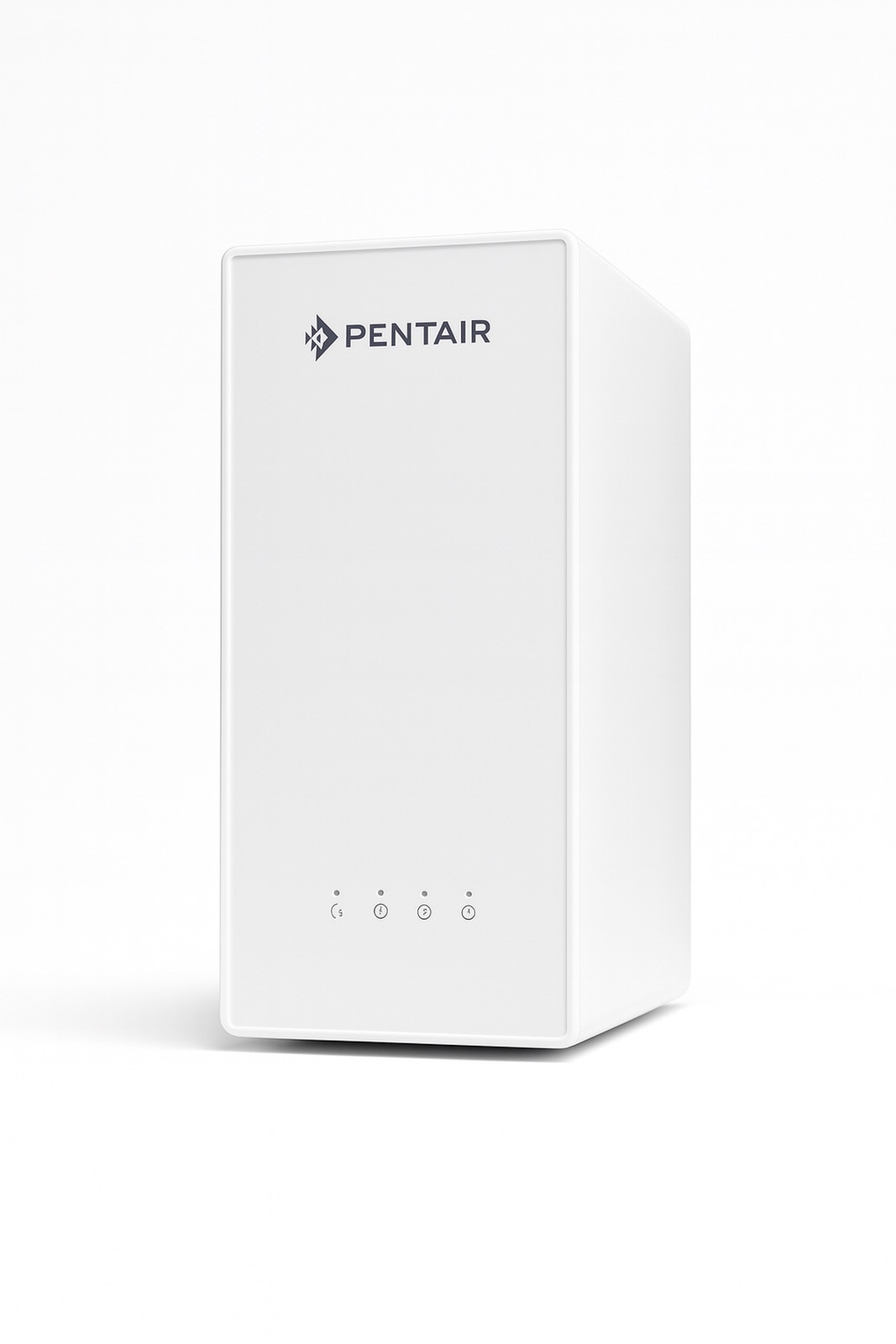
Under the sink · removes fluoride, THMs, PFAS and microplastics
Pentair ES60 under-bench RO
RRP $1,748 $1,595 Save $398
Independently lab-tested (report FW250926-28-C), including trichloromethane - the main THM. Reverse osmosis removes 99.9% of microplastics in published testing, 94%+ of PFAS, and around 90% of the fluoride where your supply adds it. No tank, and it tells you when filters are due. Ships with the first year's refill free.
ViewNAPIER WATER QUESTIONS